
This is third of fifteen essays contained within the fourth issue of the Adult Analysis Anthology, a collection of longform writing that seeks to expand the breadth of critical discourse around adult games and adult game culture. If you’d like to support the creation of more high-quality writing about adult games the full anthology is available for purchase on Itch! Anthology logo by Pillow!
Written By: Braden Liatris
Let’s start with a question: why do we play porn games?
By syntactic necessity, it can’t be because of the game part, so it must be because of the porn part. What is it about pornography that we find so compelling? That answer may seem obvious, but it still merits consideration. Erotica and pornography don’t just seek to inform or entertain, they aim to get a rise out of their audience. They stir our blood. They excite our humors. They make us wet. Therefore, we play porn games because we want to be aroused.
So what exactly do choices have to do with any of that?
You might say: empowerment is sexy! And you would be right! And we’ll get to what that means for us in due time, but not just yet. If we want to have a productive conversation around the mechanics of choice in porn games, first we must endure some theory and establish a thorough taxonomy.
For the purposes of this essay, I will identify a choice as a point in gameplay where progress halts completely until you, the player, have selected from one or more options. I will then further divide choices into three typological categories: tints, forks, and waves.
Please note that I’m going to refrain from rattling off a litany of specific citations to illustrate these categories on the assumption that if you, the reader, have played at least a few adult visual novels or dating sims, you’ll have encountered all of them in one form or another. Let your own experience be your reference.
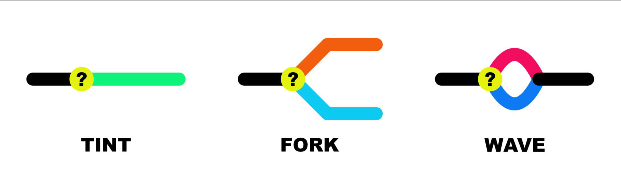
Tints are choices that alter the details of a narrative without significantly altering its course. You can choose A in any color you like, but you will proceed to B regardless.
A perfect example of a tint is the outmoded but still absurdly ubiquitous question that pops up at the very beginning of so many porn games: “Hi, protagonist, what’s your name?” Does this decision have any impact on the larger narrative? Almost certainly not, except for the unrelenting cognitive dissonance or emergent comedy that arises from the constant references to your definitely real actual name in dialogue or gameplay.
Tints are a choice only by the strictest of definitions (like the one I’ve conveniently chosen for this essay) and they present an inherent predicament: the broader your options, the less likely they are to be substantially reflected in the gameplay that follows; but the more limited your options, the less likely they are to make you feel like you, the player, have substantially influenced their outcomes.
Forks are choices that alter the course of a narrative irrevocably. If you choose A, you will not see what happens if you had chosen B unless you start the game over.
Forks tend to happen near the end of a porn game: you make a final decision and, in doing so, reveal one of some quantity of variant endings. You’ve chosen to marry the princess, aligning yourself with the very institution you once rebelled against in order to secure long days of hegemonic potency and short nights of marital duty. Or maybe you’ve spurned the princess and run off with her brother, renouncing the fetters of royalty in favor of short days living at peace with the land and long nights of carnal pleasure.
Why don’t forks happen early or often? Well, each branch that follows a fork is effectively an entirely new story, so either the designers have to put in the requisite work on each one or else you end up with a primary storyline or two plus a buffet of half-baked diversions. It’ll take you, the player, a lot longer to see everything there is to see, but you may wish you hadn’t by the time you’re through.
Waves are choices that temporarily alter the course of a narrative without significantly altering its destination. Whether you choose A or B, you will eventually proceed to C.
There are many, many different examples of waves and they are almost certainly the most frequently-utilized category out of the three. My least favorite example is the good ol’ “Do you want the blonde or the brunette?” faux dilemma. You can only choose one or the other, but everything else in the game will carry on pretty much the way it would have, regardless. You’ve made an impact on the story, sort of, but you’re probably going to fast forward through all the bits you’ve already seen when you inevitably go back to find out which one of them really is freakier in the sack. (It’s the blonde. It’s always the blonde.)
Sandbox games employ another sort of wave by allowing you to select the order of your experience through dialogue or menus. In the absence of a secondary system like a time limit, you will still see everything the game has to offer if you want to, but you get to move through it in whatever sequence you like. Today I think I’ll visit Jules and tomorrow I’ll visit Jean. Or maybe I’ll do it the other way around since, upon reflection, Jean has bigger tits.
Conversational dialogue options are also waves. Do you want to be funny? You can choose to be. Do you want to be suave? Or rude? You could choose those instead. You can be whatever sort of talker you feel like and your partners will respond in whatever way they do before the conversation moves right on to where it was already going. These little variations usually don’t amount to much in the long term, but when they do, they probably belong to our surprise subcategory of waves: breakers!
Breakers are waves that have the potential to preclude subsequent choices or events. If you choose A now, you may not be able to choose B later on.
In positing the existence of breakers, I’m treading dangerously close to design topics like relationship values and character statistics and all the things that take us away from adult visual novels and into the realm of simulations or even full-on RPGs, so I don’t want to dwell on them for longer than it takes to suggest that if waves are tints by way of a fork, breakers are forks by way of a tint. Think about it. It makes sense.
So, now that we’ve spent half the essay outlining nomenclature, I’ll ask you again: what did any of that have to do with arousal? In lieu of a straight answer, let’s indulge in a thought experiment and shift our frame of reference from you, the player of porn games, to you, the designer of porn games. If you’re making a game to arouse me, why the hell are you putting choices in it? What can they do for me?
Empowerment! Right. We’re getting to that. What else you got?
Immersion! If you make choices, you’re not playing through someone else’s story, you’re practically writing your own. What happens hits so much harder because, in some sense, you made it happen. When they put your cock in their mouth, they’re doing that because you told them to. Isn’t direct agency hotter than vicarious action? But like we talked about before, how much of an impact can I really have? Maybe I can choose where to go when, or maybe I can choose whether I’m kind of a cool dude or kind of an asshole, but do those add up to meaningfully different experiences? If the game doesn’t care whether my favorite flavor is red bean or green tea, why should I?
Content! The more branches we give you, the more there is to do. Think of all those roads you didn’t take! Now that you’ve finished the game, you can go back and play it all over again, but differently. You can choose the brunette! We swear she’s a freak, too. Hey, if you can present me with a game that I can play through two or three or more times and discover that each branch is just as fun or engaging or titillating or life-affirming as every other, I’ll be over the moon. But have you done that? Or will I just get trapped in a cycle of diminishing returns as I hunt down the last six slightly-bugged achievements so I can slap a 100% on my Steam profile?
Difficulty! Everybody loves difficulty, right? The only thing better than getting to watch people fuck on a screen is getting to know that only someone as big-brained as you could have solved the puzzle that unlocked their panties. Now there’s something.
I will gladly acknowledge that adversity makes for excellent seasoning. I remember that the prince didn’t just let me run away with him. I wooed him over the course of a dozen chapters, slowly learning his tastes so I could please him, gently uncovering his woes so I could heal him, forging the simulacrum of a real relationship and granting me a twofold sense of satisfaction when I finally, finally took him inside me. But the thing about Jean was, Jean just said: “Wanna fuck? Y/N,” and I said “Y,” because of course I wanted to—why the fuck else would I be playing a porn game?
Are choices really empowering if we’re just going through the motions?
I don’t abhor choices in my porn games on principle, but I would contend that the value of any choice in a narrative game is directly proportional to how much that game is itself about the act of making those choices. In other words: the more care and forethought have been put into the design of a choice and its consequences, the more it deserves to be in the game. Ill-considered choices are little more than texture—at best a pleasant abrasion and at worst a painful irritation.
It feels to me like way too many choices in porn games (and again, I’m not going to provide examples because they are too numerous for me to fairly single out any one of them) only exist because they’re supposed to be there. It’s not a game if it doesn’t have gameplay. Interactivity is gameplay. Choices are interactivity. If you don’t have choices, then you’re no longer designing an adult visual novel, let alone something more complex like a sim or an RPG, you’re just writing a kinetic novel—and for some fucking reason, we seem to think that’s a bad thing.
Pornography exists in a perpetual struggle for credibility. We fear to be mere and base pornographers, so we bolt our works onto the reputation of finer arts. We write (erotic) novels. We produce (erotic) films. We design (erotic) games. It’s not a porn (game), it’s a (porn) game.
The clever cunts among you may have figured out that I lied all the way back in sentence two. Both parts matter! They have to, or what the fuck are we doing here? I don’t want to play porn (games), I want to play PORN GAMES.
So what exactly do you want to make?
Do you want to make porn? That’s fantastic! Make that kinetic novel you have wet dreams about. This is me giving you permission not to put any fucking choices in it. If your aim is to be arousing, that’s all that really matters.
Do you want to make a game? That’s wonderful! You’re going to need to put in the same serious labor that any well-regarded designer would when building a game of any other genre, or else you’re just going to keep making those bad games that Bigg bemoaned all the way back in the very first essay of the Adult Analysis Anthology. Sorry, but that’s the way it is.
Are you still on the fence? That’s okay! Maybe go back and read back through the theory bits again. Chew on some critical perspectives. If you like that sort of thing, you might have your answer. Either way, it’s a start.
Braden Liatris is a falling star of consciousness caught in an electric net and swallowed by an undulating bag of water and bones. You can read their genderpunk and genrequeer smut for free at anthocene.com.
 Subscribe to the RSS feed
Mentions