This is fifteenth of fifteen essays contained within the fourth issue of the Adult Analysis Anthology, a collection of longform writing that seeks to expand the breadth of critical discourse around adult games and adult game culture. If you’d like to support the creation of more high-quality writing about adult games the full anthology is available for purchase on Itch! Anthology logo by Pillow!

Written By: Gwyndolyn Marchant

My girlfriend Juniper lives in Seattle, and I live in Toronto. Despite over three-thousand (3000) kilometers of land between us, we have a very active, healthy, and supportive relationship. We are, in the parlance of my mother, both “techie” people: we use computers and smart devices thoroughly in our lives, and are almost always online in one way or another. We are both computer scientists academically; professionally I am a pixel artist and she is a streamer. We have a weekly date, we often stream together, and we have a couple social clubs we both attend remotely. We say good morning every day with chat roleplay about physical intimacy, and we admire and tease each other for our fursonas’ – our emotive-identity avatars. We have sex once or twice every couple weeks, which is mostly metered by logistical overhead.

How exactly we “have sex” varies, but it generally involves calling over Discord and playing porn games together. This isn’t exactly a novel concept; partners have been enjoying voyeuristic sexual escapades for about as long as orgies have been a concept, which if other primates are to be believed probably predates history. [1] Watching two hot people have sex, and getting horny enough that you engage with your partner sexually as well, seems to be a normal concept among many species; even dolphins get in on the fun. [2] I can’t imagine I’d surprise anybody by describing our own behavior.

I don’t remember which of us was the first to remark upon it, but I remember a particular conversation I had between Juniper, another of her girlfriends, Zoe; and I. Our corner of our polycule has long been interested in both erotica and video games as serious art forms. We were discussing Corruption of Champions 2: a large collaborative fiction with many different authors’ writing blending together. [3][4] They observed that when making decisions, they consistently spoke in the inclusive “we” or “us”: “What should we do”, “what will happen to us next”, “isn’t it hot that this is happening to us.” I thought about it and realized quite immediately that this was how I often talked when playing games with my partners. Not just during Juniper and I’s remote play sessions, but even beyond erotica. When my wife and I play a game like Pentiment, the narrative pulls us in and we enter that same grammatical space. “We” becomes the protagonist Andreas. [5] But once we finished the game, once it was over, he became “Andreas”, and “we” became my wife and I. Something specific happens when we enter the play space. Some theorists would call this the Magic Circle.
Continue reading “The Erotic Circle”

This is fourteenth of fifteen essays contained within the fourth issue of the Adult Analysis Anthology, a collection of longform writing that seeks to expand the breadth of critical discourse around adult games and adult game culture. If you’d like to support the creation of more high-quality writing about adult games the full anthology is available for purchase on Itch! Anthology logo by Pillow!

Written By: Croomfolk

From Sex in Video Games (2007) by Brenda Brathwaite:

At the “Sexuality in Games: What’s Appropriate?” roundtable at the 2005 Game Developers Conference, one developer noted that he had no real problem with sexual content in games provided that it wasn’t “just sex for sex’s sake.”

“What’s wrong with sex for sex’s sake?” asked another developer. “Why else have sex?” she continued. “That’s the best use of sex.”

This essay is a look at a moral panic that took place around late 1993 – a panic surrounding, among other things, the release of Night Trap, a non-adult videogame that nonetheless sparked a massive public discussion on the place of adult games within the industry that still has effects to this day, having directly led to the creation of the ESRB, the content rating association still in use by the North American video games industry. Through it, I hope to offer some insight on specific brands of puritanism and their impacts on the games industry.

Continue reading “Culture Carnage: Night Trap & Witch Hunts”

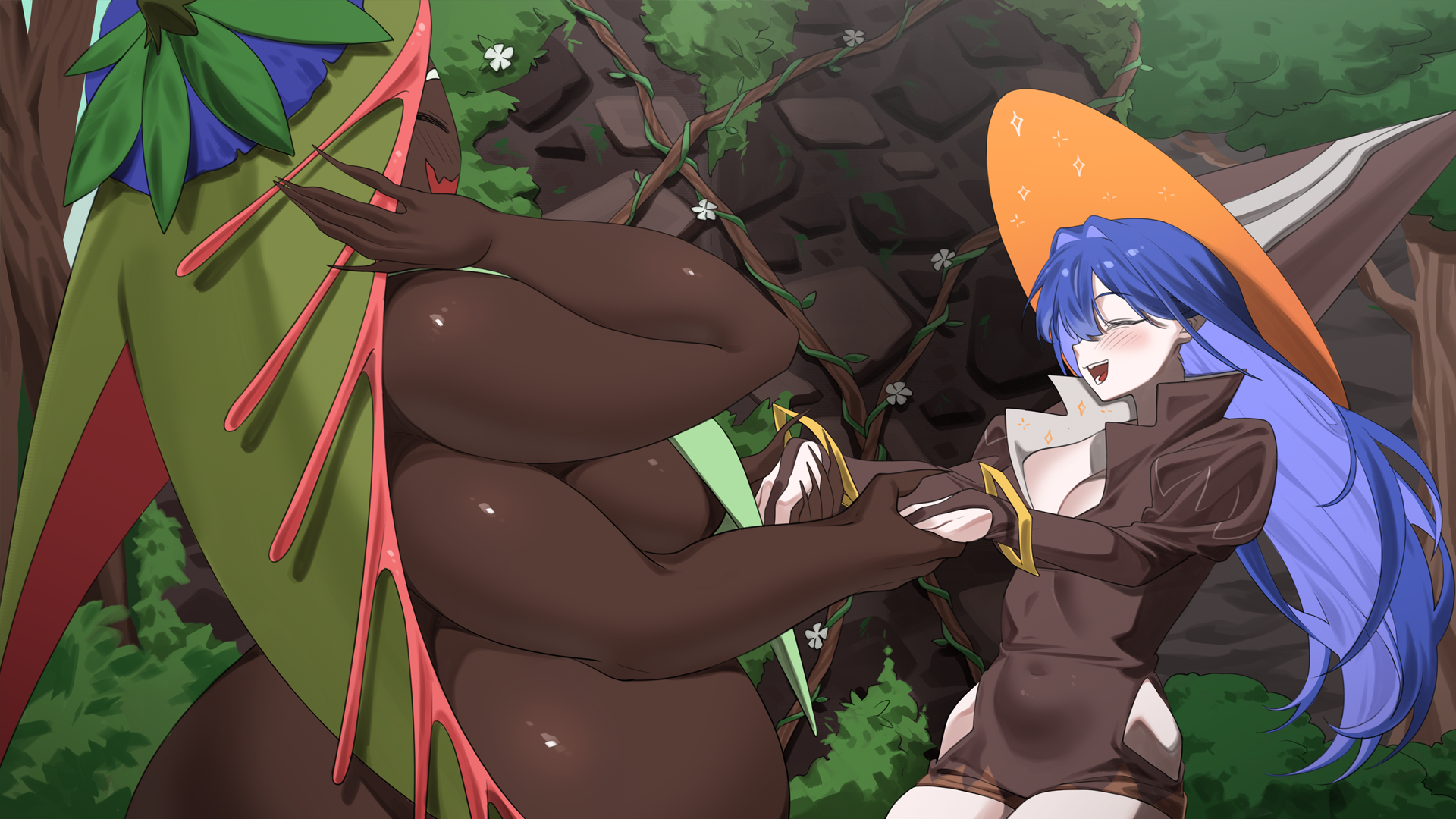
Sasha and Prim celebrate! Art by Pacha!

Happy August, all! I was awoken at 7AM this morning by the loudest thundercrash I’ve ever heard, seemingly coming from directly above my house. This was accompanied by a short, violent hailstorm of similar volume. August! Let’s get into the update!

Continue reading “August 2026: Ever-Closer To Dryad”

This is thirteenth of fifteen essays contained within the fourth issue of the Adult Analysis Anthology, a collection of longform writing that seeks to expand the breadth of critical discourse around adult games and adult game culture. If you’d like to support the creation of more high-quality writing about adult games the full anthology is available for purchase on Itch! Anthology logo by Pillow!

Written By: Liz Alfos

(This article is sort of a continuation of my previous article on Meet n’ Fuck. Reading it is not required but would help you get more quickly into the topic.)

Let me introduce myself: I am Liz Alfos, and for the past six years I’ve been managing the Museum of Screens, a project dedicated to research the History of games on the Internet, adult or otherwise. In the process, I have played a lot of adult Flash games, thousands of them in fact. My bar for appreciation is pretty low, I can find value and enjoyment in many of them, but most of the time I find myself more attracted to the short games than the longer ones.

In my previous article on Meet n’ Fuck, I described the games as “bite sized visual novels”. And I’ve made a case arguing those games did more than just providing sex scenes. Rereading it now, I realize I didn’t really get into why “bite sized” was a positive description for me. Today, I want to correct that. I want to talk about those “bite sized” adult games that can be finished in minutes, sometimes seconds. I want to tell you why I love them, and what makes them valuable in my eyes. But to do that, I have to go back to the very beginning of the internet. Please, indulge me in my hyperfixations.

Continue reading “Small Touches: A Case For (Very Short) Porn Games”

This is twelfth of fifteen essays contained within the fourth issue of the Adult Analysis Anthology, a collection of longform writing that seeks to expand the breadth of critical discourse around adult games and adult game culture. If you’d like to support the creation of more high-quality writing about adult games the full anthology is available for purchase on Itch! Anthology logo by Pillow!

Written By: Fsyco

A 2007 article about BioShock saw Clint Hocking coin the term “ludonarrative dissonance” to describe the disconnect in video games between the story being told by the gameplay elements and the story being told by the actual narrative. A commonly-cited example of this phenomenon is Nathan Drake in the Uncharted series. In the narrative, Nathan is a lovable thief with a heart of gold, but in gameplay, he guns down his fellow man without a second thought. It produces an uncanny effect where Nathan comes off like some kind of psychopath, and it feels weird to many players that these two elements never seem to address each other.

Pornographic media has its own version of this, a sort of “pornonarrative dissonance” if you will. Porn media with a plot focus often treat its writing and story as wholly separate elements. The writer comes up with things like plot, characters, and setting, and then comes up with “the sex that will happen” (assuming someone else doesn’t do that). And yet, an often overlooked element is how the narrative should inform the sex scenes, and vice versa.

When these two elements are not in agreement, the project as a whole suffers. It leads to cheesy writing and indistinct characters. It might be serviceable as porn, or the kind of “fine” you italicize or put in air quotes, but it holds the work back as a whole and prevents it from becoming truly special. To illustrate my point, I’d like to look at a few porn video games. Some of them handle this well, and others not so well. By doing so, I’d like to demonstrate how this disconnect manifests in a given work.

Continue reading “Never The Two Shall Meet: The Separation Of Story & Sex Scenes In Porn Games”